Key takeaways
- Grok led under No Clue (67/80, 83.8%); Gemini led under With Clue (75/80, 93.8%).
- Pooled accuracy was 346/480 (72.1%) under No Clue and 391/480 (81.5%) under With Clue.
- Pooled No Clue accuracy on Nigerian cases (67.5%) was below the 70.0% always-dismissed reference.
The six models (Thesis Table 3.6)
- ChatGPT 4.1 · OpenAI · short name ChatGPT
- Gemini 1.5 Pro · Google · short name Gemini
- Claude 3 Opus · Anthropic · short name Claude
- Grok 2 · xAI · short name Grok
- DeepSeek V3 · DeepSeek · short name DeepSeek
- Perplexity Sonar (Large) · Perplexity AI · short name Perplexity
Accessed through their public interfaces in April 2026 (Thesis §3.7).
The CrossLaw Benchmark: Results
This chapter reports the results of the 960 primary interactions and the three continuation experiments. Verified reasoning-quality results are not reported, for the reason given in Section 3.12.
Overall Model Performance
Tables 4.1 and 4.2 give the number of correct predictions for each model and jurisdiction, Figure 4.1 compares the two conditions for each model overall, and Figure 4.2 compares the six models within each jurisdiction.
Verdict accuracy by model and jurisdiction under No Clue (correct out of 20 per jurisdiction)
| Model | Nigeria | UK | US | Australia | Total | Accuracy |
|---|---|---|---|---|---|---|
| ChatGPT 4.1 | 14 | 16 | 13 | 12 | 55/80 | 68.8% |
| Gemini 1.5 Pro | 12 | 15 | 20 | 15 | 62/80 | 77.5% |
| Claude 3 Opus | 14 | 15 | 18 | 12 | 59/80 | 73.8% |
| Grok 2 | 16 | 18 | 18 | 15 | 67/80 | 83.8% |
| DeepSeek V3 | 10 | 20 | 9 | 9 | 48/80 | 60.0% |
| Perplexity Sonar (Large) | 15 | 12 | 13 | 15 | 55/80 | 68.8% |
| Pooled | 81/120 | 96/120 | 91/120 | 78/120 | 346/480 | 72.1% |
Overall accuracy of each model under No Clue and With Clue (80 cases per condition)
Data: Thesis Table 4.1, Thesis Table 4.2
Accuracy of each model in each jurisdiction under No Clue and With Clue (20 cases per bar). The dashed line in each panel is the majority-class reference for that jurisdiction.
Nigeria
United Kingdom
United States
Australia
Bars: correct predictions out of 20 (Thesis Tables 4.1, 4.2). Dashed line: majority-class reference from Thesis Table 4.3, drawn on the same 20-case scale.
View the figure as printed in the thesis
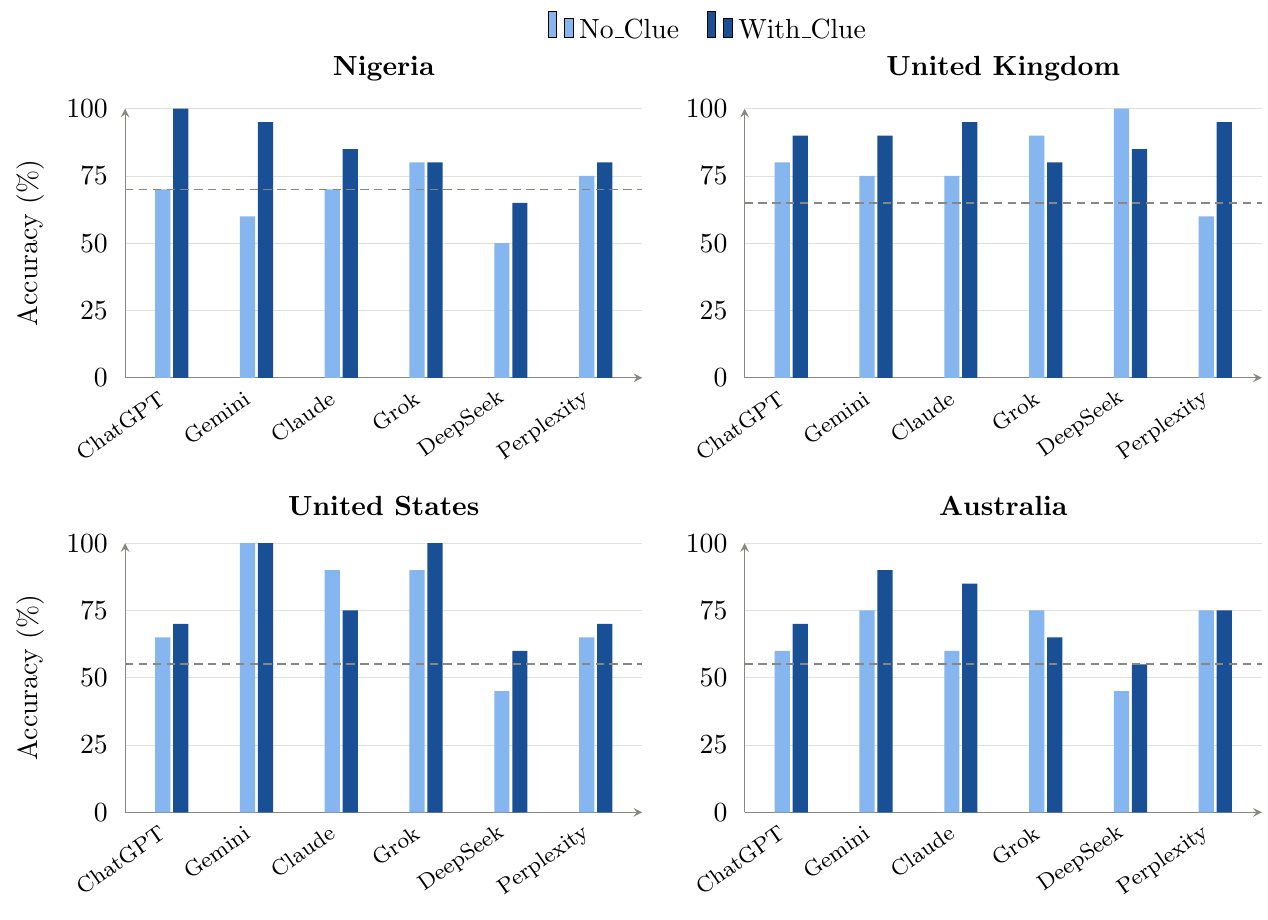
Under No Clue, Grok had the highest aggregate accuracy (67/80, 83.8%) and DeepSeek the lowest (48/80, 60.0%), although DeepSeek was correct on all 20 United Kingdom cases. Under With Clue, Gemini had the highest aggregate accuracy (75/80, 93.8%) and DeepSeek again the lowest (53/80, 66.3%). The leading model therefore changed between the two conditions. This result is limited to the CrossLaw task and sample and does not establish a general ranking of the models for legal work.
Outcome balance and majority-class reference. The share of allowed and dismissed appeals differs between the jurisdictions, so a fixed guess would not score the same in each (Table 4.3). The majority-class reference is the accuracy obtained by always predicting the more frequent outcome.
Outcome balance, majority-class reference and pooled accuracy by jurisdiction
| Jurisdiction | Allowed | Dismissed | Majority-class reference | Pooled No Clue | Pooled With Clue |
|---|---|---|---|---|---|
| Nigeria | 6 | 14 | 70.0% | 67.5% | 84.2% |
| United Kingdom | 13 | 7 | 65.0% | 80.0% | 89.2% |
| United States | 9 | 11 | 55.0% | 75.8% | 79.2% |
| Australia | 9 | 11 | 55.0% | 65.0% | 73.3% |
Outcome counts are taken from the case-level tables in Appendix 12.7. The summary rows of the working report give 12 allowed and 8 dismissed for the United Kingdom and 10 and 10 for the United States, but its case-level rows give 13 and 7, and 9 and 11, which are used here.
Under No Clue, pooled accuracy was above the majority-class reference by 15.0 points for the United Kingdom, 20.8 points for the United States and 10.0 points for Australia, and 2.5 points below it for Nigeria. Nigeria was therefore the only jurisdiction in which the six models together did not exceed a fixed guess from the facts alone. Under With Clue, pooled accuracy was above the reference in all four jurisdictions (by 14.2, 24.2, 24.2 and 18.3 points for Nigeria, the United Kingdom, the United States and Australia). The case-level scores for all 80 cases are given in Appendix 12.7.
Comparison of the models on allowed and dismissed appeals. The six models did not treat the two outcomes alike (Appendix 12.17, Table 12.57). Under No Clue every model predicted an allowed appeal at least as often as appeals were in fact allowed (37 of the 80 cases), and DeepSeek did so for 45 cases, so that it was correct on only 53.5% of the dismissed cases. Under With Clue every model predicted fewer allowed appeals than there were, and each was more accurate on dismissed than on allowed cases. On the Matthews Correlation Coefficient, which allows for the balance of outcomes, the ordering at the extremes is the same as on accuracy: Grok was highest under No Clue (0.677), Gemini under With Clue (0.874), and DeepSeek lowest in both (0.212 and 0.318). Table 12.16 compares each model’s score in each jurisdiction with the majority-class reference. Under No Clue only five of the 24 model-and-jurisdiction scores were significantly above the reference (Gemini, Claude and Grok on United States cases, and Grok and DeepSeek on United Kingdom cases), and under With Clue ten were.
Verdict accuracy by model and jurisdiction under With Clue (correct out of 20 per jurisdiction)
| Model | Nigeria | UK | US | Australia | Total | Accuracy |
|---|---|---|---|---|---|---|
| ChatGPT 4.1 | 20 | 18 | 14 | 14 | 66/80 | 82.5% |
| Gemini 1.5 Pro | 19 | 18 | 20 | 18 | 75/80 | 93.8% |
| Claude 3 Opus | 17 | 19 | 15 | 17 | 68/80 | 85.0% |
| Grok 2 | 16 | 16 | 20 | 13 | 65/80 | 81.3% |
| DeepSeek V3 | 13 | 17 | 12 | 11 | 53/80 | 66.3% |
| Perplexity Sonar (Large) | 16 | 19 | 14 | 15 | 64/80 | 80.0% |
| Pooled | 101/120 | 107/120 | 95/120 | 88/120 | 391/480 | 81.5% |
The Nigeria columns are the original No Clue (81/120, 67.5%) and With Clue (101/120, 84.2%) baselines of the Nigerian extension.
Variation Across Jurisdictions
Pooled across the six models, No Clue accuracy was 80.0% for the United Kingdom, 75.8% for the United States, 67.5% for Nigeria and 65.0% for Australia. With Clue accuracy was 89.2%, 79.2%, 84.2% and 73.3% respectively (Tables 4.1 and 4.2). Australia had the lowest pooled accuracy in both conditions.
The same model did not perform equally across jurisdictions. DeepSeek provides the clearest example: under No Clue it was correct on 20/20 United Kingdom cases but on 10/20 Nigerian and 9/20 Australian and United States cases. Gemini was correct on 20/20 United States cases under No Clue but on 12/20 to 15/20 elsewhere. Under With Clue, ChatGPT was correct on 20/20 Nigerian cases but on 14/20 United States and Australian cases.
Table 4.4 summarises the spread of each model’s accuracy across the four jurisdictions. Under No Clue, Grok and Perplexity had the narrowest range (15 points) and DeepSeek the widest (55 points). Under With Clue, Gemini had the narrowest range (10 points) and Grok the widest (35 points), so the model with the least jurisdictional variation also changed with the prompting condition.
Spread of accuracy across the four jurisdictions by model (lowest and highest jurisdiction-level accuracy, range in points, and coefficient of variation)
| No Clue | With Clue | |||||
|---|---|---|---|---|---|---|
| Model | Low–high | Range | CV | Low–high | Range | CV |
| ChatGPT 4.1 | 60–80% | 20 | 0.1242 | 70–100% | 30 | 0.1818 |
| Gemini 1.5 Pro | 60–100% | 40 | 0.2140 | 90–100% | 10 | 0.0511 |
| Claude 3 Opus | 60–90% | 30 | 0.1695 | 75–95% | 20 | 0.0961 |
| Grok 2 | 75–90% | 15 | 0.0896 | 65–100% | 35 | 0.1768 |
| DeepSeek V3 | 45–100% | 55 | 0.4462 | 55–85% | 30 | 0.1985 |
| Perplexity Sonar (Large) | 60–75% | 15 | 0.1091 | 70–95% | 25 | 0.1350 |
Table 4.5 names the jurisdictions in which each model scored highest and lowest. Under No Clue the lowest jurisdiction was Australia for four models (ChatGPT, Claude, Grok and DeepSeek, the last jointly with the United States), Nigeria for Gemini and the United Kingdom for Perplexity. Under With Clue each model’s profile changed: ChatGPT’s highest jurisdiction moved from the United Kingdom to Nigeria, Claude’s from the United States to the United Kingdom, and
Highest and lowest jurisdiction for each model, with the gap in percentage points
| No Clue | With Clue | |||||
|---|---|---|---|---|---|---|
| Model | Highest | Lowest | Gap | Highest | Lowest | Gap |
| ChatGPT 4.1 | UK (80%) | AU (60%) | 20 | NG (100%) | US, AU (70%) | 30 |
| Gemini 1.5 Pro | US (100%) | NG (60%) | 40 | US (100%) | UK, AU (90%) | 10 |
| Claude 3 Opus | US (90%) | AU (60%) | 30 | UK (95%) | US (75%) | 20 |
| Grok 2 | UK, US (90%) | AU (75%) | 15 | US (100%) | AU (65%) | 35 |
| DeepSeek V3 | UK (100%) | US, AU (45%) | 55 | UK (85%) | AU (55%) | 30 |
| Perplexity Sonar (Large) | NG, AU (75%) | UK (60%) | 15 | UK (95%) | US (70%) | 25 |
NG = Nigeria, AU = Australia, UK = United Kingdom, US = United States.
Perplexity’s lowest jurisdiction under No Clue (the United Kingdom) became its highest.
On the No Clue results the working reports gave each model a one-line jurisdictional profile: Gemini as specialised in United States law, DeepSeek in United Kingdom law, Claude as showing a moderate advantage on United States cases with strong retrieval on United Kingdom cases, Perplexity as favouring Commonwealth jurisdictions (Nigeria and Australia), Grok as the most balanced and ChatGPT as jurisdiction-agnostic. Table 4.5 shows why these labels are not adopted here. They describe one condition only, and most do not hold under With Clue. The description of ChatGPT as the most consistent or most jurisdiction-independent model, which also appears in the RD2 proposal, is not supported in either condition: its range and coefficient of variation were third among the six models under No Clue, and under With Clue its coefficient of variation was fifth and its range joint fourth with DeepSeek’s (Table 4.4).
A chi-square test of the association between correctness and jurisdiction was run for each model and condition (Appendix 12.8, Table 12.18). Under No Clue the association was significant for DeepSeek (χ2 = 17.92, p = 0.0005) and Gemini (χ2 = 9.46, p = 0.0237). Under With Clue it was significant for ChatGPT (χ2 = 9.35, p = 0.0250) and Grok (χ2 = 8.12, p = 0.0435), and no longer significant for DeepSeek or Gemini. Which models showed a jurisdiction-dependent result therefore also depended on the prompting condition.
A prespecified ordered comparison tested whether No Clue accuracy followed the ordering United Kingdom (high-resource), Australia (mid-resource) and Nigeria (low-resource) within the Commonwealth lineage (Table 4.6).
Commonwealth-lineage comparison under No Clue (Jonckheere–Terpstra test of the ordering UK, Australia, Nigeria)
| Model | UK | Australia | Nigeria | Observed pattern | p |
|---|---|---|---|---|---|
| ChatGPT 4.1 | 80.0% | 60.0% | 70.0% | Mixed | 0.5874 |
| Gemini 1.5 Pro | 75.0% | 75.0% | 60.0% | Lower Nigerian result | 0.4157 |
| Claude 3 Opus | 75.0% | 60.0% | 70.0% | Mixed | 0.7861 |
| Grok 2 | 90.0% | 75.0% | 80.0% | Mixed | 0.5874 |
| DeepSeek V3 | 100.0% | 45.0% | 50.0% | Marked decline | 0.0067 |
| Perplexity Sonar (Large) | 60.0% | 75.0% | 75.0% | Reverse pattern | 0.4157 |
Only DeepSeek showed a statistically significant ordered decline (p = 0.0067). The other five models showed mixed, weaker or reversed patterns. The results therefore do not support a general claim that performance decreases as legal-resource availability decreases. Because resource classification is confounded with jurisdiction, differences may also reflect doctrine, case composition, citation practice, digitisation, recency or possible case familiarity. Under With Clue no model showed a significant ordered trend, including DeepSeek (p = 0.2778). The test statistics for both conditions are given in Appendix 12.8.
A separate comparison tested whether accuracy on United States cases, the jurisdiction most represented in prior legal AI evaluation, differed from accuracy on Nigerian cases (Mann–Whitney U with Cliff’s delta, 20 cases against 20). Under No Clue the difference was significant only for Gemini (United States 100%, Nigeria 60%, p = 0.0019, δ = 0.40). Under With Clue it was significant for ChatGPT in the opposite direction (United States 70%, Nigeria 100%, p = 0.0093, δ = −0.30) and for Grok (United States 100%, Nigeria 80%, p = 0.0398, δ = 0.20). The other models showed no significant difference in either condition (Appendix 12.8, Table 12.19). The results do not support a general claim that the models performed better on United States than on Nigerian cases.
Legal domains. For each jurisdiction a chi-square test compared the distribution of correct and incorrect predictions across the represented legal domains. The test indicated domain-related variation in Nigeria (p < 0.0001), the United States (p = 0.0173) and Australia (p = 0.0003), but not in the United Kingdom (p = 0.2803). The test statistics were χ2 = 65.388 (df = 15) for Nigeria, 25.942 (df = 14) for the United States, 45.992 (df = 16) for Australia and 22.080 (df = 18) for the United Kingdom, and χ2 = 162.994 (df = 73, p < 0.0001) across all jurisdictions. These values are as recorded. Three of the p-values do not correspond exactly to the statistic and degrees of freedom recorded with them (Appendix 12.8), although no conclusion about significance changes. The degrees of freedom show that the domain labels used in these tests were fine-grained, with 15 to 19 labels for the 20 cases of a jurisdiction, so the tests are close to tests of variation between individual cases and many cells are sparse. These are within-sample associations. They do not establish that any domain or jurisdiction is inherently easier for LLMs. A coarser descriptive breakdown by legal domain is given in Appendix 12.9.
Supporting tables from the thesis appendices
Supporting statistics (Table 12.16, Table 12.18, Table 12.19, Table 12.20, Table 12.21, Table 12.57)
Correct predictions out of 20 by model and jurisdiction, marked where the score differs from the majority-class reference (exact binomial test, two-sided, p<0.05)
| No Clue | With Clue | |||||||
|---|---|---|---|---|---|---|---|---|
| Model | NG | UK | US | AU | NG | UK | US | AU |
| ChatGPT 4.1 | 14 | 16 | 13 | 12 | 20+ | 18+ | 14 | 14 |
| Gemini 1.5 Pro | 12 | 15 | 20+ | 15 | 19+ | 18+ | 20+ | 18+ |
| Claude 3 Opus | 14 | 15 | 18+ | 12 | 17 | 19+ | 15 | 17+ |
| Grok 2 | 16 | 18+ | 18+ | 15 | 16 | 16 | 20+ | 13 |
| DeepSeek V3 | 10 | 20+ | 9 | 9 | 13 | 17 | 12 | 11 |
| Perplexity Sonar (Large) | 15 | 12 | 13 | 15 | 16 | 19+ | 14 | 15 |
| Reference | 14 | 13 | 11 | 11 | 14 | 13 | 11 | 11 |
^+ significantly above the majority-class reference. No score is significantly below it. NG = Nigeria, UK = United Kingdom, US = United States, AU = Australia. The reference row gives the score obtained by always predicting the more frequent outcome. No correction for the 48 comparisons is applied.
Chi-square tests of the association between correctness and jurisdiction, by model and condition (df=3)
| No Clue | With Clue | |||
|---|---|---|---|---|
| Model | χ² | p | χ² | p |
| ChatGPT 4.1 | 2.0364 | 0.5649 | 9.3506 | 0.0250 |
| Gemini 1.5 Pro | 9.4624 | 0.0237 | 2.3467 | 0.5036 |
| Claude 3 Opus | 4.8426 | 0.1837 | 3.1373 | 0.3709 |
| Grok 2 | 2.4799 | 0.4789 | 8.1231 | 0.0435 |
| DeepSeek V3 | 17.9167 | 0.0005 | 4.6401 | 0.2001 |
| Perplexity Sonar (Large) | 1.5709 | 0.6660 | 4.3750 | 0.2237 |
Bold values are below 0.05. Several expected cell counts are below five, so the p-values are approximate.
Mann–Whitney U comparison of verdict scores on United States and Nigerian cases (20 cases each). Positive δ indicates higher accuracy on United States cases.
| No Clue | With Clue | |||||||
|---|---|---|---|---|---|---|---|---|
| Model | U | p | δ | Effect | U | p | δ | Effect |
| ChatGPT 4.1 | 190 | 0.7515 | −0.05 | Negligible | 140 | 0.0093 | −0.30 | Small |
| Gemini 1.5 Pro | 280 | 0.0019 | +0.40 | Medium | 210 | 0.3421 | +0.05 | Negligible |
| Claude 3 Opus | 240 | 0.1231 | +0.20 | Small | 180 | 0.4466 | −0.10 | Negligible |
| Grok 2 | 220 | 0.3939 | +0.10 | Negligible | 240 | 0.0398 | +0.20 | Small |
| DeepSeek V3 | 190 | 0.7665 | −0.05 | Negligible | 190 | 0.7593 | −0.05 | Negligible |
| Perplexity Sonar (Large) | 180 | 0.5065 | −0.10 | Negligible | 180 | 0.4820 | −0.10 | Negligible |
Bold values are below 0.05. No correction for the twelve comparisons is applied. With binary scores, δ equals the difference between the two accuracy proportions (the “gap” column of the notebook). Effect labels follow the thresholds in Section 3.9. The notebook labelled ChatGPT's With Clue value of −0.30 as medium, although it falls in the small band.
Models ranked by coefficient of variation across the four jurisdictions (lower is more consistent)
| No Clue | With Clue | |||||
|---|---|---|---|---|---|---|
| Rank | Model | CV | Band | Model | CV | Band |
| 1 | Grok 2 | 0.0896 | Exceptional | Gemini 1.5 Pro | 0.0511 | Exceptional |
| 2 | Perplexity Sonar (Large) | 0.1091 | Good | Claude 3 Opus | 0.0961 | Exceptional |
| 3 | ChatGPT 4.1 | 0.1242 | Good | Perplexity Sonar (Large) | 0.1350 | Good |
| 4 | Claude 3 Opus | 0.1695 | Moderate | Grok 2 | 0.1768 | Moderate |
| 5 | Gemini 1.5 Pro | 0.2140 | High | ChatGPT 4.1 | 0.1818 | Moderate |
| 6 | DeepSeek V3 | 0.4462 | Extreme | DeepSeek V3 | 0.1985 | Moderate |
Jonckheere–Terpstra test for an ordered trend (United Kingdom, Australia, Nigeria): accuracy in each jurisdiction, statistic and p as recorded
| No Clue | With Clue | |||||
|---|---|---|---|---|---|---|
| Model | J | p | UK / AU / NG (%) | J | p | UK / AU / NG (%) |
| ChatGPT 4.1 | 560 | 0.5874 | 80 / 60 / 70, mixed | 640 | 0.5874 | 90 / 70 / 100, mixed |
| Gemini 1.5 Pro | 540 | 0.4157 | 75 / 75 / 60, lower Nigeria | 620 | 0.7861 | 90 / 90 / 95, stable |
| Claude 3 Opus | 580 | 0.7861 | 75 / 60 / 70, mixed | 560 | 0.5874 | 95 / 85 / 85, stable |
| Grok 2 | 560 | 0.5874 | 90 / 75 / 80, mixed | 600 | 1.0000 | 80 / 65 / 80, mixed |
| DeepSeek V3 | 400 | 0.0067 | 100 / 45 / 50, decline | 520 | 0.2778 | 85 / 55 / 65, attenuated |
| Perplexity Sonar (Large) | 660 | 0.4157 | 60 / 75 / 75, reverse | 540 | 0.4157 | 95 / 75 / 80, mixed |
With the tie-corrected variance, DeepSeek's No Clue result is p=0.0010 and no other result is below 0.05 (for example, Gemini and Perplexity under No Clue p=0.3047, and DeepSeek under With Clue p=0.1776).
Class-based measures by model and condition (80 cases; positive class = Appeal Allowed)
| Condition | Model | Predicted Allowed | Recall on Allowed | Recall on Dismissed | Precision | F1 | Balanced accuracy | MCC |
|---|---|---|---|---|---|---|---|---|
| No Clue | ChatGPT 4.1 | 38 | 25/37 (67.6%) | 30/43 (69.8%) | 0.658 | 0.667 | 68.7% | 0.373 |
| Gemini 1.5 Pro | 37 | 28/37 (75.7%) | 34/43 (79.1%) | 0.757 | 0.757 | 77.4% | 0.547 | |
| Claude 3 Opus | 42 | 29/37 (78.4%) | 30/43 (69.8%) | 0.690 | 0.734 | 74.1% | 0.481 | |
| Grok 2 | 40 | 32/37 (86.5%) | 35/43 (81.4%) | 0.800 | 0.831 | 83.9% | 0.677 | |
| DeepSeek V3 | 45 | 25/37 (67.6%) | 23/43 (53.5%) | 0.556 | 0.610 | 60.5% | 0.212 | |
| Perplexity Sonar (Large) | 42 | 27/37 (73.0%) | 28/43 (65.1%) | 0.643 | 0.684 | 69.0% | 0.380 | |
| With Clue | ChatGPT 4.1 | 33 | 28/37 (75.7%) | 38/43 (88.4%) | 0.848 | 0.800 | 82.0% | 0.649 |
| Gemini 1.5 Pro | 36 | 34/37 (91.9%) | 41/43 (95.3%) | 0.944 | 0.932 | 93.6% | 0.874 | |
| Claude 3 Opus | 35 | 30/37 (81.1%) | 38/43 (88.4%) | 0.857 | 0.833 | 84.7% | 0.698 | |
| Grok 2 | 32 | 27/37 (73.0%) | 38/43 (88.4%) | 0.844 | 0.783 | 80.7% | 0.624 | |
| DeepSeek V3 | 34 | 22/37 (59.5%) | 31/43 (72.1%) | 0.647 | 0.620 | 65.8% | 0.318 | |
| Perplexity Sonar (Large) | 35 | 28/37 (75.7%) | 36/43 (83.7%) | 0.800 | 0.778 | 79.7% | 0.597 |
Precision and F1 refer to the Allowed class. Recall on Dismissed is the specificity. MCC = Matthews Correlation Coefficient.
Legal domains (Table 12.23, Table 12.26, Table 12.27, Table 12.28)
Chi-square tests of the association between correctness and legal domain (as recorded in the analysis notebook)
| Scope | χ² | df | p |
|---|---|---|---|
| All jurisdictions | 162.994 | 73 | <0.0001 |
| Nigeria | 65.388 | 15 | <0.0001 |
| United States | 25.942 | 14 | 0.0173 |
| Australia | 45.992 | 16 | 0.0003 |
| United Kingdom | 22.080 | 18 | 0.2803 |
Accuracy by coarse legal domain, recomputed from the case-level scores (correct predictions out of six models × cases)
| Jurisdiction and domain | Cases | No Clue | With Clue | Reported |
|---|---|---|---|---|
| Nigeria | ||||
| Contract (labour) | 001, 005, 007 | 15/18 (83.3%) | 15/18 (83.3%) | 77.8% |
| Contract (land and mortgage) | 004, 012, 013, 020 | 10/24 (41.7%) | 23/24 (95.8%) | 58.3% |
| Tort | 002, 008, 014, 015, 017 | 27/30 (90.0%) | 29/30 (96.7%) | 72.0% |
| Commercial (IP, banking, admiralty) | 003, 009, 010, 011, 018, 019 | 21/36 (58.3%) | 26/36 (72.2%) | 66.7% |
| Criminal | 016 | 6/6 (100.0%) | 6/6 (100.0%) | 100.0% |
| United Kingdom | ||||
| Tort | 001, 004, 005, 006, 008, 010, 011 | 34/42 (81.0%) | 37/42 (88.1%) | 76.2% |
| Contract | 002, 017, 020 | 15/18 (83.3%) | 17/18 (94.4%) | 88.9% |
| Banking and commercial | 003, 012, 016 | 14/18 (77.8%) | 18/18 (100.0%) | 88.9% |
| Property and equity | 013, 014 | 6/12 (50.0%) | 9/12 (75.0%) | 58.3% |
| Employment | 015 | 6/6 (100.0%) | 3/6 (50.0%) | 83.3% |
| IP and patent | 018 | 6/6 (100.0%) | 6/6 (100.0%) | 100.0% |
| Civil procedure | 009 | 6/6 (100.0%) | 5/6 (83.3%) | 100.0% |
| United States | ||||
| Intellectual property | 001, 005, 006, 008, 015, 016, 017 | 32/42 (76.2%) | 35/42 (83.3%) | 79.8% |
| Employment and arbitration | 003, 014, 018, 020 | 19/24 (79.2%) | 18/24 (75.0%) | 87.5% |
| Civil procedure | 002, 004, 011 | 10/18 (55.6%) | 14/18 (77.8%) | 66.7% |
| Bankruptcy | 010, 012 | 10/12 (83.3%) | 11/12 (91.7%) | 75.0% |
| Banking and preemption | 007 | 5/6 (83.3%) | 5/6 (83.3%) | 83.3% |
| Administrative | 009 | 6/6 (100.0%) | 5/6 (83.3%) | 100.0% |
| RICO (civil) | 013 | 4/6 (66.7%) | 2/6 (33.3%) | 50.0% |
| Australia | ||||
| Contract | 001, 005, 010, 011, 013, 014 | 21/36 (58.3%) | 22/36 (61.1%) | 63.9% |
| Commercial | 018, 019, 020 | 17/18 (94.4%) | 14/18 (77.8%) | 88.9% |
| Equity | 002, 012, 016 | 9/18 (50.0%) | 15/18 (83.3%) | 58.3% |
| IP | 004, 017 | 9/12 (75.0%) | 10/12 (83.3%) | 75.0% |
| Tort | 009, 015 | 9/12 (75.0%) | 10/12 (83.3%) | 66.7% |
| Civil procedure | 006, 007 | 6/12 (50.0%) | 8/12 (66.7%) | 58.3% |
| Public international | 008 | 5/6 (83.3%) | 5/6 (83.3%) | 83.3% |
| Property | 003 | 2/6 (33.3%) | 4/6 (66.7%) | 50.0% |
Reported = average No Clue accuracy stated in the working report.
Correct predictions by coarse legal domain and model (cases correct under No Clue / With Clue)
| Jurisdiction and domain | Cases | ChatGPT 4.1 | Gemini 1.5 Pro | Claude 3 Opus | Grok 2 | DeepSeek V3 | Perplexity Sonar (Large) |
|---|---|---|---|---|---|---|---|
| Nigeria | |||||||
| Contract (labour) | 3 | 2/3 | 3/3 | 3/3 | 3/2 | 2/2 | 2/2 |
| Contract (land and mortgage) | 4 | 1/4 | 1/4 | 1/4 | 3/4 | 2/3 | 2/4 |
| Tort | 5 | 5/5 | 5/5 | 5/4 | 3/5 | 4/5 | 5/5 |
| Commercial (IP, banking, admiralty) | 6 | 5/6 | 2/6 | 4/5 | 5/4 | 1/2 | 4/3 |
| Criminal | 1 | 1/1 | 1/1 | 1/1 | 1/1 | 1/1 | 1/1 |
| United Kingdom | |||||||
| Tort | 7 | 5/6 | 5/6 | 5/7 | 6/5 | 7/6 | 6/7 |
| Contract | 3 | 3/3 | 2/2 | 2/3 | 3/3 | 3/3 | 2/3 |
| Banking and commercial | 3 | 2/3 | 3/3 | 2/3 | 3/3 | 3/3 | 1/3 |
| Property and equity | 2 | 1/2 | 1/2 | 1/1 | 1/1 | 2/1 | 0/2 |
| Employment | 1 | 1/0 | 1/1 | 1/1 | 1/1 | 1/0 | 1/0 |
| IP and patent | 1 | 1/1 | 1/1 | 1/1 | 1/1 | 1/1 | 1/1 |
| Civil procedure | 1 | 1/1 | 1/1 | 1/1 | 1/0 | 1/1 | 1/1 |
| United States | |||||||
| Intellectual property | 7 | 4/5 | 7/7 | 7/5 | 7/7 | 3/5 | 4/6 |
| Employment and arbitration | 4 | 3/3 | 4/4 | 3/2 | 4/4 | 2/2 | 3/3 |
| Civil procedure | 3 | 0/2 | 3/3 | 2/3 | 3/3 | 1/1 | 1/2 |
| Bankruptcy | 2 | 2/2 | 2/2 | 2/2 | 2/2 | 0/1 | 2/2 |
| Banking and preemption | 1 | 1/1 | 1/1 | 1/1 | 0/1 | 1/1 | 1/0 |
| Administrative | 1 | 1/0 | 1/1 | 1/1 | 1/1 | 1/1 | 1/1 |
| RICO (civil) | 1 | 1/0 | 1/1 | 1/0 | 0/1 | 0/0 | 1/0 |
| Australia | |||||||
| Contract | 6 | 4/4 | 5/4 | 3/5 | 4/3 | 2/2 | 3/4 |
| Commercial | 3 | 3/3 | 3/3 | 3/3 | 2/1 | 3/2 | 3/2 |
| Equity | 3 | 1/1 | 2/3 | 1/2 | 1/3 | 2/3 | 2/3 |
| IP | 2 | 2/2 | 1/2 | 1/2 | 2/2 | 1/1 | 2/1 |
| Tort | 2 | 1/2 | 2/2 | 2/2 | 2/1 | 0/1 | 2/2 |
| Civil procedure | 2 | 0/0 | 1/2 | 1/2 | 2/1 | 0/1 | 2/2 |
| Public international | 1 | 1/1 | 1/1 | 1/0 | 1/1 | 1/1 | 0/1 |
| Property | 1 | 0/1 | 0/1 | 0/1 | 1/1 | 0/0 | 1/0 |
Draft risk level, verification requirement and note for each domain group, as recorded in the working report
| Domain group | Risk | Verification requirement | Note in the working report |
|---|---|---|---|
| Nigeria | |||
| Contract (labour) | Medium | Verify the reasoning (Type II risk) | NG_001 as a possible case of correct verdict with general reasoning |
| Contract (land and mortgage) | High | Mandatory manual verification of document hierarchy | NG_020: no model correct under No Clue |
| Tort | Medium | Standard verification of case law | Strong performance overall |
| Commercial (IP, banking, admiralty) | High | Mandatory procedural check for limitation periods | NG_009: no model correct under No Clue |
| Criminal | Low | Routine verification | All models correct |
| United Kingdom | |||
| IP and patent | Low | Routine verification | UK_018 correct for all models |
| Civil procedure | Low | Routine verification | UK_009 correct for all models under No Clue |
| Contract | Low | Routine verification | Strong performance |
| Banking and commercial | Low | Routine verification | Strong performance |
| Employment | Medium | Standard verification | UK_015 contested under With Clue |
| Tort | Medium | Verify the reasoning on recent (2026) decisions | UK_004 (2026) contested |
| Property and equity | High | Mandatory manual verification | UK_013 (proprietary estoppel) difficult |
| United States | |||
| Administrative | Low | Routine verification | US_009 correct for all models under No Clue |
| Employment and arbitration | Low | Routine verification | Strong performance |
| Banking and preemption | Medium | Standard verification | Moderate difficulty |
| Intellectual property | Medium | Verify against current statutes | Well-documented doctrine |
| Bankruptcy | Medium | Standard verification | Mixed performance |
| Civil procedure | High | Manual check of jurisdiction rules | US_011 (Mallory) difficult |
| RICO (civil) | High | Mandatory manual verification | US_013 (2025), described in the draft as the most difficult United States case (US_001 was at least as difficult, at 3/6 and 2/6) |
| Australia | |||
| Commercial | Low | Routine verification | Strong performance |
| Public international | Medium | Standard verification | Strong performance |
| IP | Medium | Standard verification | Strong performance |
| Tort | High | Manual check of duty of care | Moderate performance |
| Contract | High | Manual check of purposive intent | AU_013: no model correct under No Clue |
| Equity | High | Mandatory manual verification | AU_012 difficult (1/6) |
| Civil procedure | High | Manual check of court rules | AU_006 difficult (2/6) |
| Property | High | Mandatory manual verification | Mixed performance |